How AI Revenue Cycle Management Services Are Transforming Healthcare Finance
How AI Is Revolutionizing Revenue Cycle Management in Healthcare
Introduction
The healthcare industry is facing unprecedented financial challenges. Rising administrative costs, increasing claim denials, workforce shortages, evolving payer requirements, and growing patient financial responsibility are putting immense pressure on healthcare organizations. As providers strive to maintain financial stability while delivering high-quality patient care, many are turning to Artificial Intelligence (AI) to modernize their Revenue Cycle Management (RCM) operations.
AI-powered Revenue Cycle Management is rapidly becoming a strategic advantage for healthcare organizations. By leveraging machine learning, predictive analytics, natural language processing (NLP), and automation technologies, healthcare providers can streamline billing processes, reduce denials, improve collections, and accelerate reimbursements. According to a report by EY, healthcare organizations are increasingly adopting AI-driven RCM solutions to enhance financial resilience, improve operational efficiency, and optimize revenue performance.
Understanding AI Revenue Cycle Management
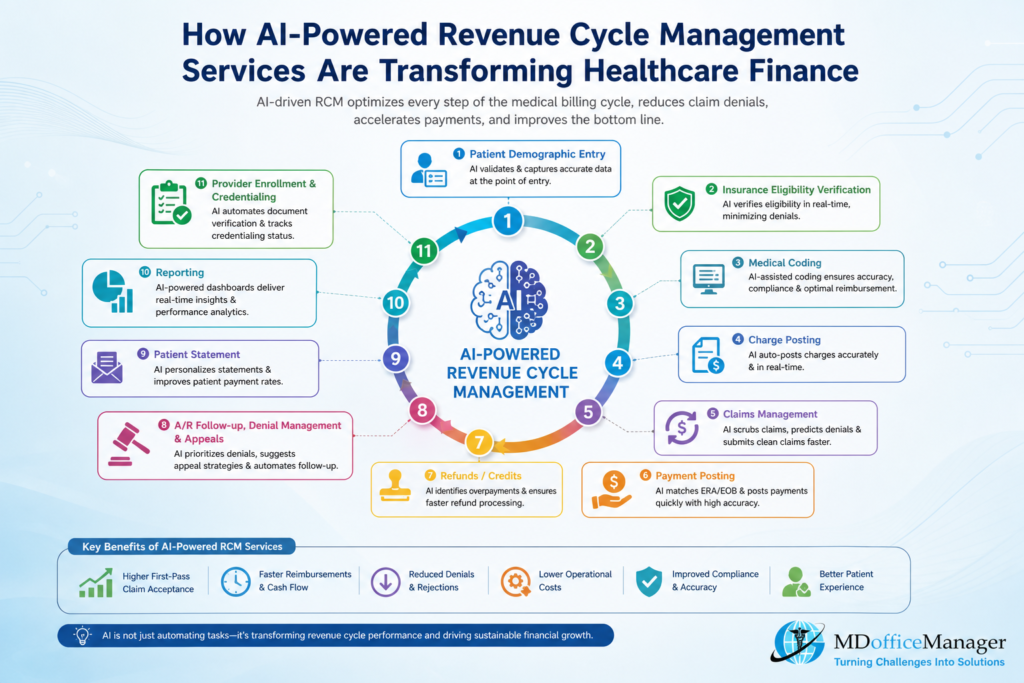
Revenue Cycle Management encompasses every financial process associated with a patient’s healthcare journey—from appointment scheduling and insurance verification to claim submission, payment collection, and reimbursement reconciliation.
Historically, many of these processes have relied heavily on manual intervention. Administrative staff spend countless hours verifying insurance eligibility, reviewing documentation, coding encounters, submitting claims, tracking denials, and managing collections. These manual workflows often create inefficiencies, increase labor costs, and introduce opportunities for human error.
AI transforms this traditional approach by introducing intelligent automation throughout the revenue cycle. Machine learning algorithms can analyze vast datasets to identify trends and anomalies, while NLP technologies can extract relevant information from clinical documentation. These capabilities enable healthcare organizations to automate repetitive tasks, improve decision-making, and capture revenue more effectively. As highlighted in the EY report on AI-driven healthcare revenue cycle management, organizations are increasingly recognizing AI as a critical tool for improving financial performance while reducing operational burdens.
Why Healthcare Organizations Are Re-Evaluating Their Revenue Cycle Strategies
Healthcare finance leaders are under growing pressure to do more with fewer resources. Revenue cycle teams frequently face staffing shortages, increasing denial rates, and complex reimbursement requirements that make traditional workflows difficult to sustain.
One of the most significant challenges is claim denials. Every denied claim represents delayed revenue and additional administrative work. According to industry research, preventable denials remain one of the largest sources of revenue leakage for healthcare providers. Denials often stem from documentation errors, coding inaccuracies, missing information, or payer-specific requirements that are overlooked during the claims process.
At the same time, healthcare organizations are dealing with rising administrative expenses. A significant portion of healthcare spending is consumed by administrative activities, many of which involve repetitive manual processes. These inefficiencies not only increase operational costs but also contribute to employee burnout and workforce turnover.
AI-powered RCM solutions address these challenges by automating routine workflows and enabling teams to focus on higher-value activities that directly impact financial performance.
AI-Powered Denial Prevention and Predictive Analytics
One of the most transformative applications of AI in healthcare finance is predictive denial management.
Traditionally, healthcare organizations discover claim issues only after a denial occurs. Staff members must then investigate the cause, correct errors, and resubmit claims, creating delays that negatively affect cash flow. AI changes this process by identifying potential problems before claims are submitted.
Machine learning models analyze historical claims data, payer behavior, coding patterns, and documentation requirements to determine which claims are most likely to be denied. Revenue cycle teams can then proactively address these issues before submission, significantly improving first-pass acceptance rates.
Research published in Deep Claim: Payer Response Prediction from Claims Data with Deep Learning demonstrated that AI models can effectively predict payer responses by analyzing large healthcare claims datasets.
Similarly, the American Hospital Association has highlighted how AI-driven analytics can help healthcare organizations reduce denials, optimize workflows, and improve revenue cycle efficiency. By shifting from a reactive to a proactive denial management strategy, healthcare organizations can reduce revenue leakage and improve financial stability.
Enhancing Medical Coding Accuracy Through Artificial Intelligence
Medical coding is one of the most critical components of the revenue cycle. Even minor coding errors can lead to reimbursement delays, compliance concerns, and denied claims.
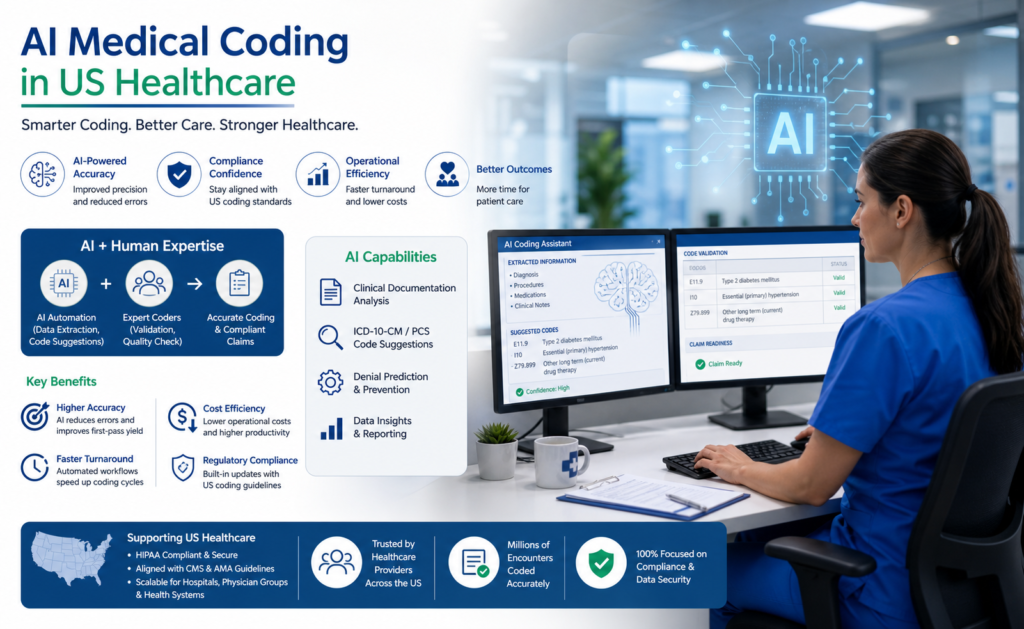
AI-powered coding platforms utilize Natural Language Processing to review clinical documentation and automatically recommend appropriate diagnosis and procedure codes. These systems analyze physician notes, clinical reports, and encounter documentation in real time, helping coders identify inaccuracies and ensure compliance with coding standards.
The result is a more accurate and efficient coding process that reduces human error while supporting appropriate reimbursement. Healthcare organizations can improve coding consistency, decrease claim rework, and accelerate reimbursement timelines.
Recent research published through PubMed Central has demonstrated how AI technologies are increasingly being integrated into healthcare financial operations to improve coding accuracy and revenue cycle outcomes.
Automating Claims Processing and Workflow Management
Claims processing is often one of the most labor-intensive aspects of Revenue Cycle Management. Manual claim review, validation, submission, and follow-up require significant staff resources and can create bottlenecks throughout the revenue cycle.
AI enables healthcare organizations to automate many of these processes. Intelligent systems can review claims for errors, validate payer-specific requirements, identify missing documentation, and prioritize claims that require immediate attention.
Instead of relying solely on staff members to manually review every claim, AI-driven platforms can process large volumes of claims rapidly and consistently. This automation reduces turnaround times and helps providers receive reimbursements more quickly.
Healthcare organizations implementing AI-powered claims management frequently report improvements in operational efficiency, lower administrative costs, and higher clean-claim rates.
Revenue Leakage Detection and Financial Optimization
Revenue leakage remains a persistent challenge across the healthcare industry. Lost revenue can result from underpayments, missed charges, coding discrepancies, contract compliance issues, and billing errors. AI provides a powerful solution by continuously monitoring financial transactions and identifying patterns that may indicate lost revenue opportunities. Rather than waiting for periodic audits, healthcare organizations can use AI-driven analytics to detect anomalies in real time.
These insights allow finance teams to identify underpayments, recover missed reimbursements, and improve contract management processes. As healthcare reimbursement models become increasingly complex, AI’s ability to analyze large volumes of financial data becomes an essential tool for protecting organizational revenue.
EY notes that advanced analytics and AI are becoming critical components of financial resilience strategies, helping healthcare organizations better manage cash flow and optimize revenue performance.
Improving the Patient Financial Experience
Revenue Cycle Management is no longer limited to interactions between healthcare providers and insurance payers. Today’s patients are responsible for a growing share of healthcare costs, making patient financial engagement an increasingly important component of healthcare finance.
AI can significantly enhance the patient experience by providing personalized payment options, automated communication, and predictive payment planning. Intelligent systems can estimate patient financial responsibility, recommend payment plans, and deliver customized reminders that improve collection rates while maintaining a positive patient experience.
By making healthcare billing more transparent and accessible, providers can strengthen patient satisfaction while improving financial outcomes.
The Business Impact of AI Revenue Cycle Management
The financial benefits of AI-powered Revenue Cycle Management extend across the organization.
Healthcare providers that successfully implement AI-driven RCM solutions often experience reduced denial rates, faster reimbursement cycles, lower administrative costs, improved staff productivity, and enhanced financial visibility. Predictive analytics provide leadership teams with actionable insights into revenue performance, allowing organizations to make more informed strategic decisions.
Moreover, AI helps alleviate workforce challenges by reducing the burden of repetitive administrative tasks. Instead of spending valuable time on manual data entry and claim reviews, revenue cycle professionals can focus on complex cases, payer negotiations, and strategic financial initiatives.
These improvements create a stronger financial foundation that supports long-term organizational growth.
The Future of AI in Healthcare Finance
The future of Revenue Cycle Management will be increasingly driven by artificial intelligence. Emerging technologies such as Generative AI and Agentic AI are expected to further automate administrative workflows, enhance decision support, and improve financial forecasting capabilities.
As healthcare organizations continue to navigate reimbursement challenges and operational pressures, AI will play an increasingly important role in helping providers optimize revenue, improve efficiency, and maintain financial sustainability.
Organizations that invest in AI-powered RCM solutions today are positioning themselves to remain competitive in a rapidly evolving healthcare landscape.
The Realistic Outlook
Artificial Intelligence is fundamentally transforming healthcare finance by modernizing every stage of the Revenue Cycle Management process. From predictive denial prevention and intelligent coding to automated claims processing and revenue leakage detection, AI empowers healthcare organizations to improve financial performance while reducing administrative complexity.
As healthcare systems face growing economic pressures, AI Revenue Cycle Management services are becoming more than a technological innovation—they are a strategic necessity. Providers that embrace AI-driven financial operations will be better equipped to accelerate cash flow, improve operational efficiency, enhance patient satisfaction, and build a more sustainable future for healthcare delivery.